Skip to content
POLARISWIRE DATA

Sunspot and solar cycle data

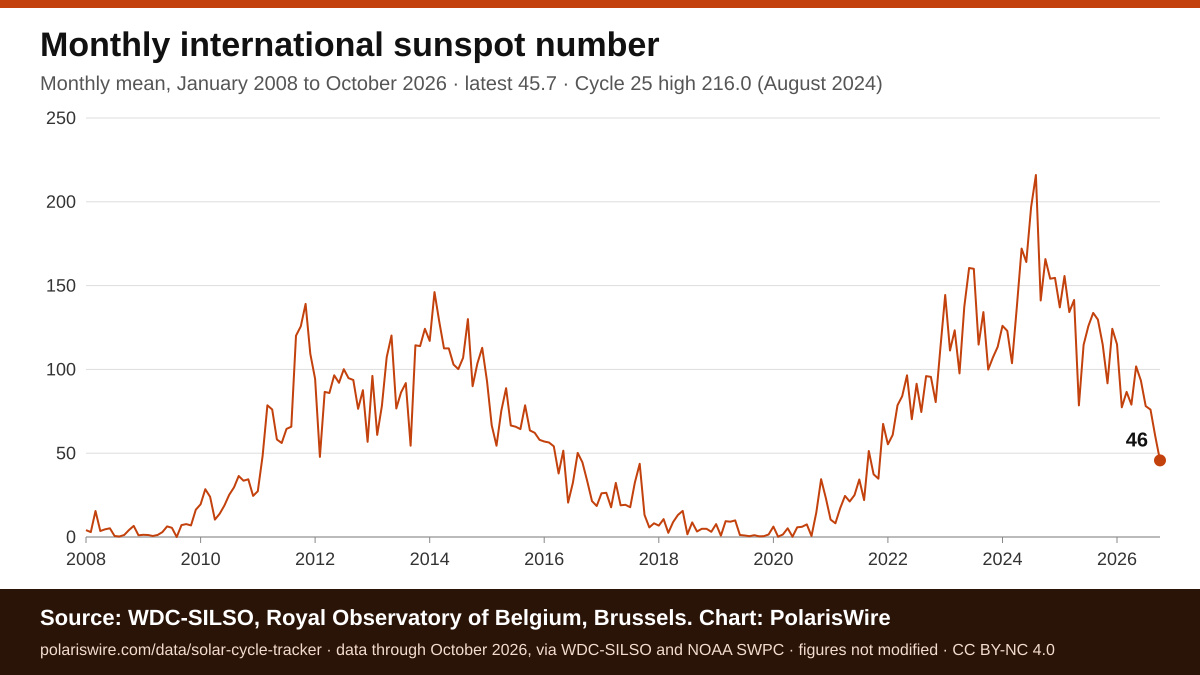
The monthly mean international sunspot number was 45.7 in October 2026, down 60.2% on October 2025. The highest monthly value so far in Solar Cycle 25 is 216.0, in August 2024. These pages follow the official sunspot number from WDC-SILSO at the Royal Observatory of Belgium and the F10.7 solar radio flux, and turn them into statistics, charts and a lookup that anyone can use, cite and link to.

Updated 2 November 2026. Source: NOAA Space Weather Prediction Center; WDC-SILSO, Royal Observatory of Belgium. Figures are refreshed when new monthly values are published.

Tracker, statistics and lookup

Solar Cycle 25 tracker

The international sunspot number averaged 45.7 in October 2026, with a mean F10.7 solar radio flux of 108.5 solar flux units. The highest monthly value so far in Solar Cycle 25 is 216.0, recorded in August 2024.

The last 24 months with the F10.7 radio flux and a 12-month average, a chart since 2008 and the full monthly series as a CSV.

Solar cycle statistics 2026

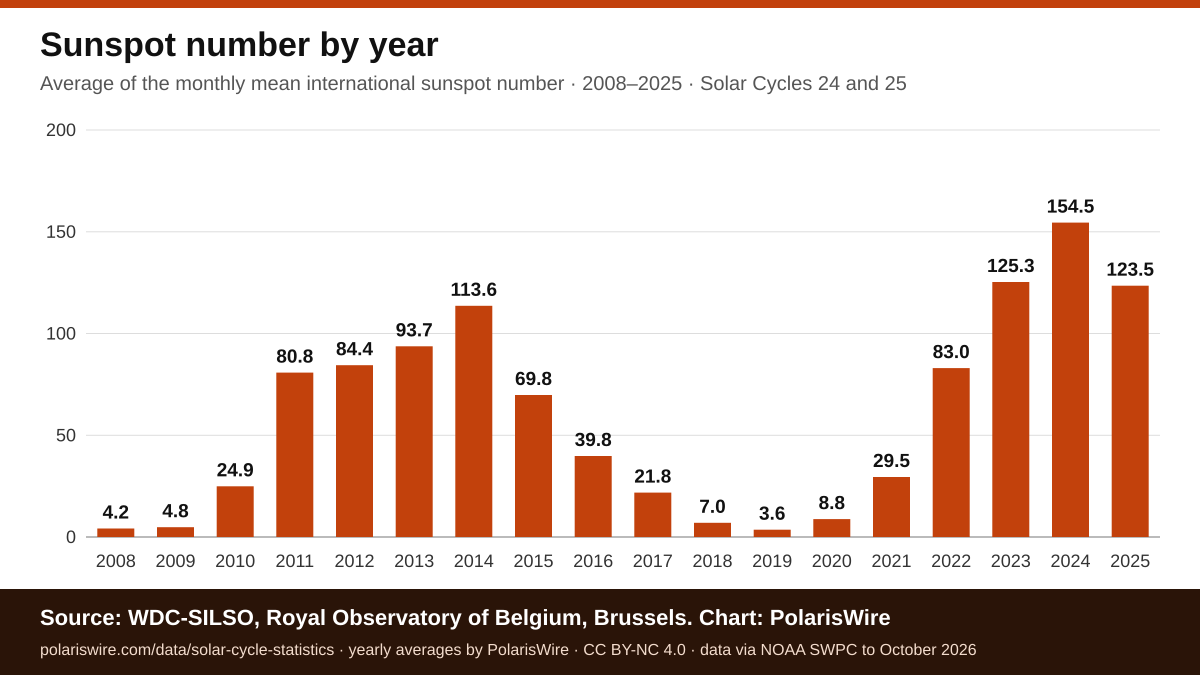
44 key figures on Solar Cycle 25, each with its own link, plus yearly averages, highs and lows of the sunspot number and F10.7 flux from 2008 to 2025.

Copy-ready citations, two CSV files and a downloadable bar chart.

Sunspot cycle lookup

Enter any month or year since January 1749, or pick one of the 25 numbered solar cycles, to see the sunspot number, which cycle it fell in and how it compares with Solar Cycle 25.

3,334 months of official sunspot numbers, from January 1749 to October 2026.

Solar cycle comparison

Compare Solar Cycle 25 with all 24 earlier cycles at the same number of months after their minimum, or put any two cycles head to head.

Over its first 83 months, Solar Cycle 25 ranks 18th of 25 cycles by average sunspot number. Chart and CSV of every cycle month.

Free downloads

The files below are built from the same SILSO and NOAA data as the pages and are updated daily with them. The sunspot numbers come from WDC-SILSO, Royal Observatory of Belgium, which distributes them under a CC BY-NC 4.0 licence (SILSO data policy). You may reuse these files for non-commercial purposes under the same CC BY-NC 4.0 licence, with credit to PolarisWire and WDC-SILSO, Royal Observatory of Belgium, and a link to the page you used. Commercial use is not covered by this licence.

How to credit PolarisWire

Please credit "PolarisWire. Data: WDC-SILSO, Royal Observatory of Belgium, Brussels." and link to the page you used. Each statistic, solar cycle and year has its own anchor, so you can link straight to the figure you quote. Please keep the credit line on chart images. SILSO may revise recent months, so recent values can change.